

Core Thesis
Enterprise value is created when technology spend directly operationalizes business strategy. Many modernization efforts underperform not due to technological limitations, but because organizational structures treat IT as a downstream service provider rather than a core strategic partner. Achieving alignment requires unifying decision rights, performance metrics, and governance frameworks across leadership.
The root cause of business–IT misalignment is structural. Business goals and technology roadmaps are often developed independently, creating disconnected priorities. Without a shared understanding of the capabilities the business needs, technology investments can become disconnected from the outcomes they are intended to support.
Your technology portfolio should always aim to accelerate strategic outcomes; otherwise, you are just funding a high-overhead experiment.
Core Pillars of Strategic Business–IT Alignment
Before evaluating software licenses, cloud migrations, or modernizations, business and technology leaders must establish a shared understanding of how technology investments support enterprise priorities. Four principles provide that foundation:
1. Shared Accountability
Business leaders and technology executives must co-own P&L outcomes and delivery timelines.
2. Strategic Capability Mapping
Every technology investment must map to a specific core business capability and strategic objective.
3. Adaptive Governance
Oversight mechanisms should enable rapid capital allocation adjustments based on real-time market feedback.
4. Value-Based Prioritization
Technical initiatives must be ordered strictly by their return on investment, operational risk reduction, or revenue contribution.
Where Business–IT Alignment Breaks Down
Traditional approaches to business–IT alignment often treat IT as a service provider responsible for fulfilling requests from individual business units. Business leaders identify operational problems, and technology teams respond by purchasing or developing solutions. This approach creates fragmented systems and disconnected data.
True alignment requires a translation layer. Decision architecture bridges the gap between executive strategy and system deployment. It establishes how decisions are made, how resources are allocated, and how competing priorities are resolved before implementation begins or vendor commitments are made.
Key Drivers of Business–IT Friction
Optimizing a single functional area (e.g., automated marketing lead generation) without addressing downstream operational capacity (e.g., manual contracting) creates bottlenecks rather than throughput.
Selecting platforms based on theoretical capacity rather than immediate operational reality. Unnecessary complexity acts as a tax on every future business initiative.
Spending months drafting multi-year target-state diagrams while failing to map a practical transition path that delivers value every 90 days.
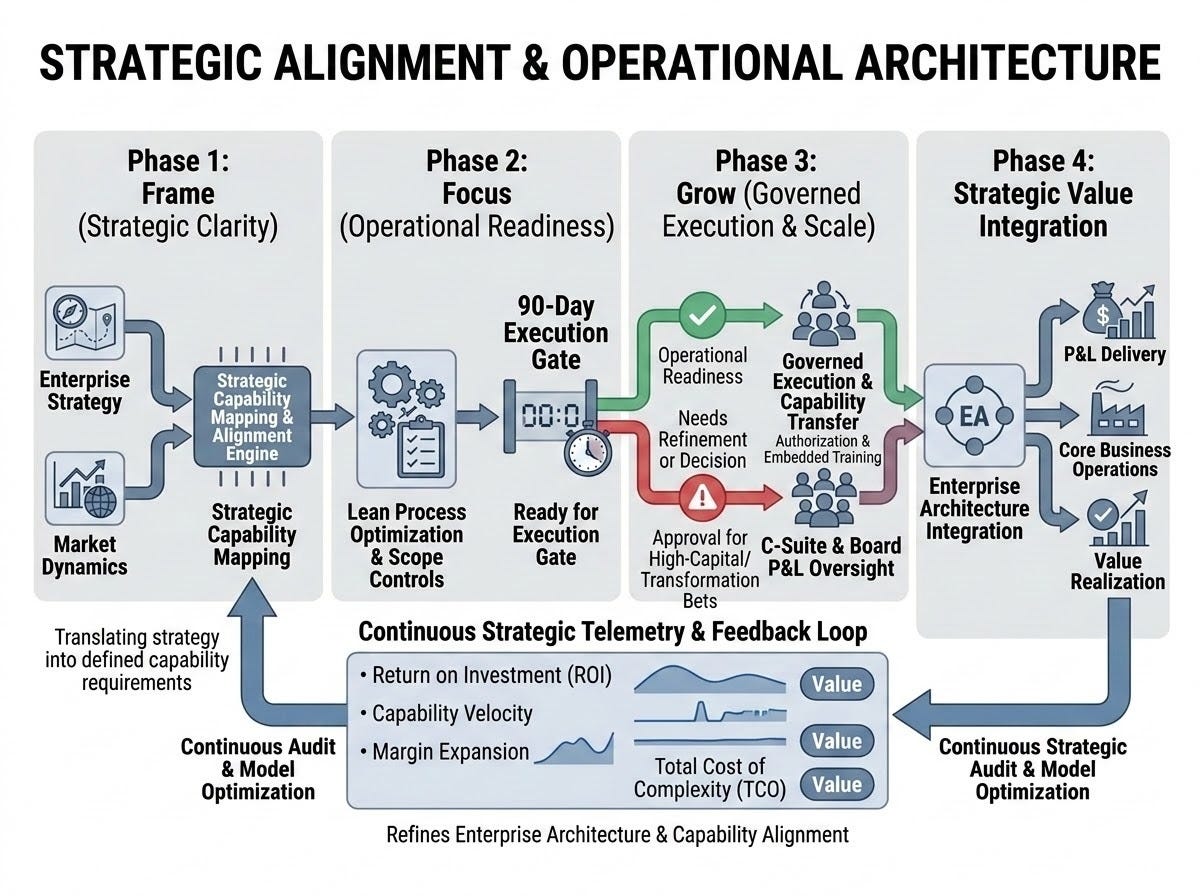
The Framework: Frame, Focus, Grow
To convert capital expenditure into measurable enterprise value, high-performing organizations should use a structured three-phase operating model:
1. Frame: Establishing Business-Led Mandates
Technology investments should begin with a clearly defined business need, not a vendor pitch or a predetermined technology solution. Enterprise Architecture frameworks can help leaders connect organizational capabilities to strategic objectives.
Before committing resources, test every capital request against three questions:
Which specific P&L metric does this capability change?
Who owns the decision rights and business outcome across cross-functional boundaries?
What is the minimum viable architecture required to achieve this result?
2. Focus: Simplifying Before Scaling
Rigorous Operational Excellence disciplines like Lean Six Sigma dictate that you must never automate an unoptimized process. Automating waste simply speeds up the generation of defects and organizational friction.
Before introducing new systems, leaders should examine existing workflows, eliminate avoidable manual workarounds, and clarify how responsibilities move across departments. Leaders must ensure current technology supports processes that are understood and fit for purpose before adding anything new.
3. Grow: Driving Governed Scale
As technology initiatives expand, organizations need governance that allows them to scale successful capabilities without introducing unmanaged risk or unnecessary complexity. Data governance and architectural standards provide the foundation for consistent operations by establishing reliable data, clear ownership, and defined expectations for how systems work together.
Effective governance should make execution easier instead of creating another layer of bureaucracy. When teams operate within clear architectural and operational guardrails, they can make decisions with greater confidence, reduce avoidable rework, and build on capabilities already established elsewhere in the organization.
Self-Audit: Business–IT Alignment Readiness
Review your current portfolio of technology initiatives against this peer critique framework:
Can your project leads explain the business case in two sentences without using industry buzzwords?
Is every initiative assigned to an accountable business owner who owns the P&L outcome, rather than an isolated project manager?
Does the program build internal capabilities and transfer skills to your teams, or does it leave you dependent on external vendor maintenance?
Is there a clear Enterprise Architecture transition plan that demonstrates how each platform supports operational excellence over a 90-day execution cycle?
Moving Strategy to Execution
Strategic alignment should not be treated as an annual planning exercise. It must become an ongoing discipline that connects business priorities to measurable results. Organizations that maintain this connection are better positioned to avoid unnecessary complexity, adapt to changing needs, and realize the value of their technology investments.
Aim to align people, processes, and systems around the capabilities the business needs to succeed. When this alignment occurs, technology becomes a more effective driver of enterprise value.