

Core Thesis
Uncontrolled AI consumption can erode margins faster than it creates value. When organizations treat generative AI as an open-ended utility, costs grow without a clear link to business outcomes. Capturing its full potential requires C-suite leaders to move beyond tracking vendor spend and start governing the economics of intelligence through Enterprise Architecture and Operational Excellence.
The Diagnostic Framework: The Cost Trap
McKinsey research highlights a growing challenge in enterprise AI: consumption is scaling faster than many organizations can measure and manage it. In its research, 93% of respondents reported exceeding their AI budgets, while enterprise AI spending increased nearly fourfold as organizations moved from isolated use cases to broader adoption. McKinsey also estimates that 20% to 30% of AI spend often goes unaccounted for because investments are scattered across vendors, tools, and business units.
AI consumption is also difficult to predict. The same task can generate dramatically different token volumes depending on the model, workflow, and agent behavior, making costs harder to forecast and budgets less reliable. Traditional software procurement, which relies heavily on fixed licenses and predictable usage, no longer works because AI introduces consumption-based pricing and demand that must be managed continuously. Meanwhile, fragmented adoption creates hidden spend through duplicate model subscriptions, oversized prompts, repeated requests, and unmonitored agent loops.
The underlying problem is that organizations often lack the visibility and operational controls needed to connect consumption to business value.
The Governance Gap
Traditional FinOps practices help organizations track and allocate technology costs, but AI requires greater control over consumption as it happens. Retrospective reporting can identify budget overruns, but it cannot prevent inefficient workloads from continuing to consume resources. At the same time, restricting experimentation can limit adoption and delay potential returns.
Without controls embedded in the technology architecture, applications often develop their own model integrations, security policies, and monitoring processes. As adoption expands, these disconnected implementations increase maintenance costs, complicate oversight, and make it harder to shift workloads between providers. Organizations need an operating model that brings cost visibility and execution controls together, allowing them to manage consumption in real time while preserving the flexibility to evolve.
The Unified AI Tokenomics Operational Model
Operational Excellence requires a structured model transition strategy rooted in TOGAF Enterprise Architecture principles. You cannot manage AI value at the application layer; you must govern it through a unified operational control model sitting between user request ingress and model execution.
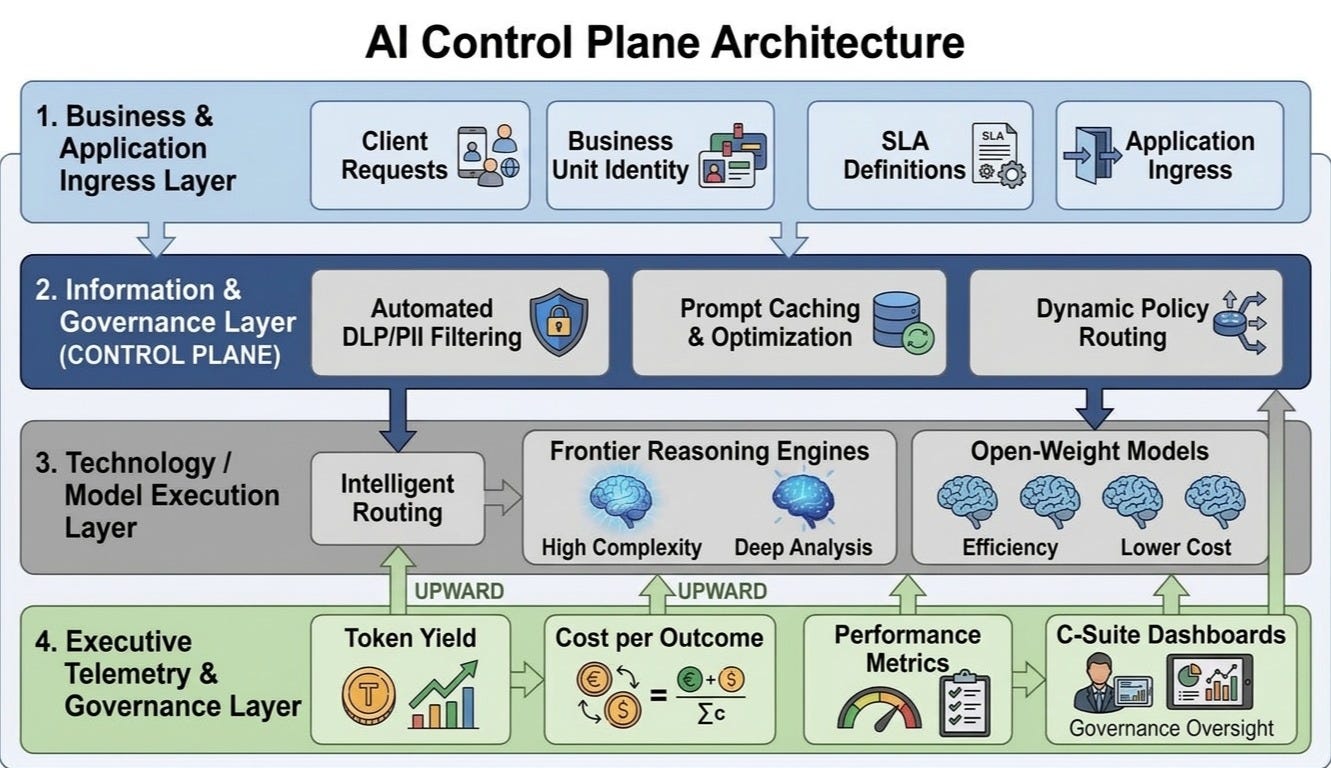
By decoupling business applications from specific foundation models, enterprise architects enforce standardized routing, data privacy controls, and financial telemetry across every transaction.
Ingress Management & Baseline Telemetry. Capture request metadata, user identity, business unit ownership, and SLA targets before dispatching the payload to establish full transactional transparency.
Dynamic Policy & Cost Routing. Apply real-time automated data loss prevention, PII redaction, and prompt optimization (e.g., caching to cut input costs) while dynamically steering queries between open-weight models and frontier reasoning engines based on task complexity.
Executive P&L Telemetry. Stream real-time token yields, unit cost per business outcome, quality scores, and drift metrics directly into CFO and CIO governance dashboards for continuous operational oversight.
Operational Hurdles
AI investments should be evaluated by the business value they produce, not simply by how much intelligence they consume. Applying Lean Six Sigma principles to AI operations helps organizations identify waste, reduce process variation, and improve the economics of each completed task. Three priorities are essential to making AI consumption financially sustainable:
Outcome-Based Unit Economics: Pivot financial accounting from raw, unhedged token consumption to cost per verified business outcome, measuring value per claim processed, code review completed, or customer transaction resolved.
Model Right-Sizing & Prompt Efficiency: Enforce rigorous prompt standardization, response caps, and contextual caching across all applications to eliminate output inflation and redundant inference spend.
Architectural & Sourcing Flexibility: Maintain multi-model agility across proprietary and open-weight model architectures to maintain continuous pricing leverage, mitigate vendor lock-in, and optimize workloads.
Scaling Execution
Managing AI demand is no longer an IT operational concern; it’s a fundamental test of executive stewardship. To capture sustainable operating leverage and prevent margin erosion, leaders should focus on three pragmatic directives:
Establish Centralized Tokenomics Governance: Create a unified operational control plane across all business units to enforce real-time model routing, prompt optimization, and total spend visibility before deploying capital to new agentic workloads.
Shift Accounting from Usage to Business Outcome Yield: Require executive sponsors to justify AI compute against concrete P&L metrics, measuring cost per resolved transaction or verified business deliverable rather than raw token throughput.
Enforce Architectural Agility: Decouple application layers from vendor-specific foundation models to maintain pricing power, eliminate single-supplier lock-in, and continuously rebalance workloads between open-weight and proprietary architectures.
Leaders who embed these disciplines into their operating models can scale AI without allowing complexity and consumption to outpace the value they create. By treating intelligence as a controlled strategic asset, businesses can translate generative capabilities into measurable enterprise value and an enduring competitive advantage.