

Core Thesis
Data governance needs to be treated as an execution discipline instead of a policy exercise. Gartner predicts that by 2027, 60% of organizations that fail to address the cultural challenges surrounding data governance will fail to govern AI successfully. When governance becomes slow, fragmented, or disconnected from how work gets done, teams find ways around it, creating hidden risks. Effective governance should be grounded in operational excellence, embedding accountability and controls into daily workflows so governance creates measurable business value rather than unnecessary friction.
Current State vs. Future State Comparison
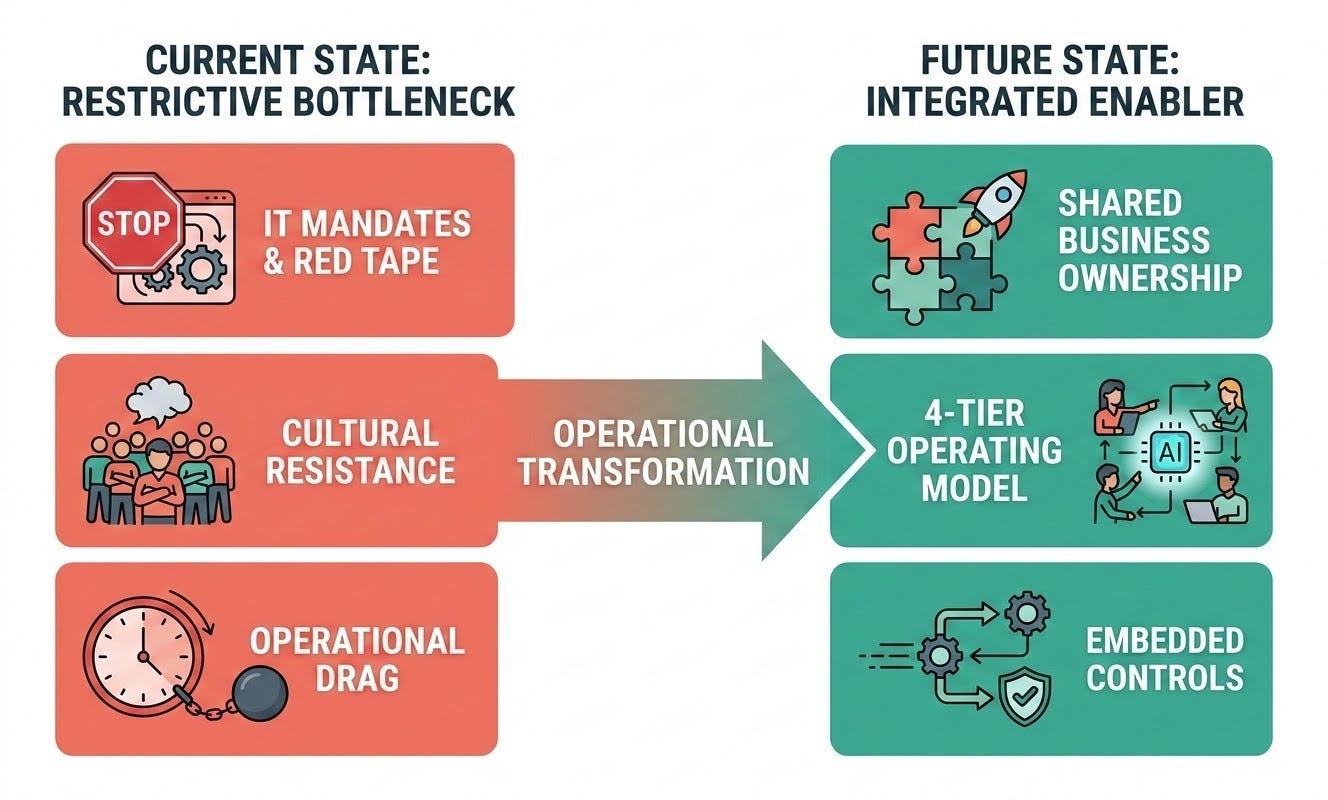
The Cultural Bottleneck
Organizations spend millions making data “AI-ready,” but often overlook the people who use and govern it. Gartner found that 60% of data and analytics leaders identify cultural resistance as the primary reason governance initiatives fail, compared with 40% who cite funding constraints.
Executives demand rapid AI adoption and measurable returns, while business teams can experience centralized governance as red tape. When governance creates more friction than value, teams begin looking for workarounds, moving risk outside the processes designed to manage it.
Operational excellence offers a different approach. Governance should clarify ownership, build capability, and embed controls directly into workflows rather than relying on policies that sit outside them.
Watch for these three cultural gaps:
The Accountability Void: Treating data governance as an IT responsibility separates accountability from the business processes and outcomes that governance is meant to support.
The Literacy Deficit: Without practical data and AI literacy embedded in daily workflows, employees struggle to understand governance requirements, slowing adoption and increasing dependence on centralized teams.
The Friction Penalty: When governance adds unnecessary steps without making the business safer or more effective, teams have greater incentive to work around it, weakening both compliance and operational control.
Why Command-and-Control Governance Fails
Top-down mandates may restrict visible AI activity, but they do not necessarily change how work gets done. When governance relies primarily on prohibition and centralized approval, employees can move experimentation into less visible channels, creating shadow AI that is harder to monitor and manage.
When governance sits outside the workflows, tools, and decisions it is intended to govern, compliance becomes something employees work around rather than something embedded in how work gets done.
From Governance Gatekeeper to Execution System
We must transform governance from a gatekeeper function into an integrated operational discipline. Guardrails need to adjust dynamically based on business impact, speed requirements, and risk levels.
Traditional governance often places controls around the workflow: submit a request, wait for review, obtain approval, then execute. An operational approach moves those controls closer to the point of execution, making the safe and compliant path easier to follow.
Effective governance should be:
Business-Owned: Tie governance targets directly to revenue and strategic goals to maintain executive engagement.
Risk-Proportional: Controls should reflect the potential impact of the activity. Low-risk experimentation should not face the same requirements as high-impact AI applications involving sensitive data or critical decisions.
Embedded: Data quality checks, security validation, approvals, and training should be integrated into existing tools and workflows wherever possible rather than creating separate processes that employees must navigate.
Continuous: Governance should extend beyond initial approval. Usage, performance, data quality, risk, and business outcomes should be monitored continuously so controls can evolve as the technology and its use change.
The Economics of Governance
Governance has a cost, whether leaders measure it or not.
Every approval, review, manual control, and exception process consumes time and organizational capacity. Those costs are justified when they reduce meaningful risk or protect enterprise value. They become a problem when the cost of control exceeds the risk it is designed to manage.
Low-risk activities should move through lightweight controls. Higher-risk applications should receive deeper scrutiny. And wherever possible, controls should be automated and embedded into the systems where work already happens.
This creates a more useful measure of governance effectiveness: the amount of risk reduced relative to the operational friction introduced.
Scaling AI Execution
Governance is necessary to scale safely and protect the enterprise; moving forward recklessly without guardrails creates unacceptable risk. However, governance must be integrated directly at the strategy table from day one. When governance is treated as an afterthought or a reactive compliance check, it is perpetually running to catch up rather than proactively shaping success.
The goal is to build clear, high-speed runways for execution, not larger bureaucratic walls. Treating governance as a strategic business enabler grounded in operational excellence gives teams the clarity, safety, and alignment needed to succeed at scale.