

Core Thesis
Deploying AI without redesigning operating models substantially limits its potential business value. Many enterprise AI initiatives improve individual tasks without delivering meaningful financial returns because existing workflows remain unchanged. To realize measurable ROI, executive teams must move beyond software experimentation and redesign how work flows across the enterprise. This shift connects productivity gains to operational performance and bottom-line results.
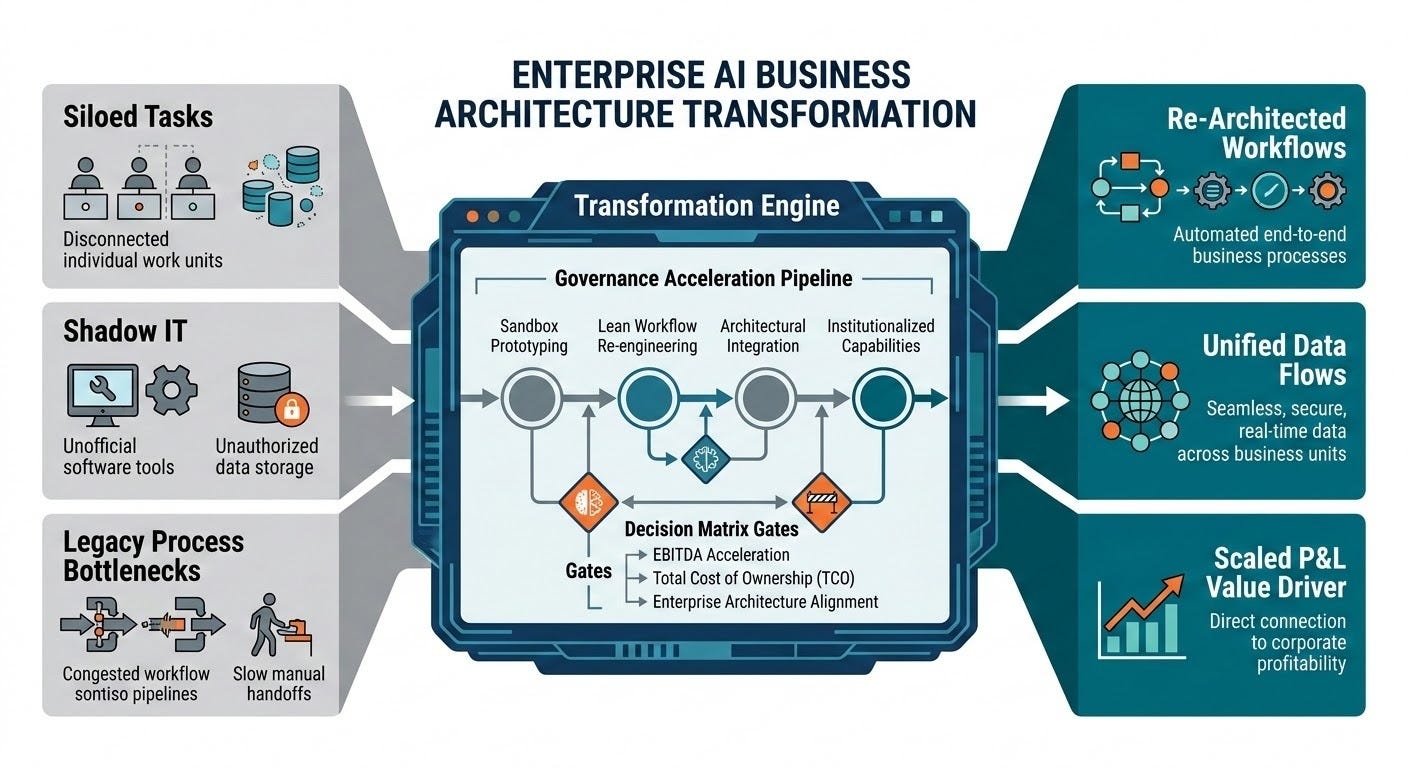
Trapping Gains in Silos
Organizations spend millions purchasing GenAI seats and launching departmental pilots, yet P&L impact remains elusive. Recent research by McKinsey & Company has emphasized that while AI fundamentally changes individual tasks, real value materializes most when organizations restructure how work flows across teams and business units. When AI is treated primarily as a personal productivity tool, efficiency gains remain isolated rather than translating into broader operational improvements.
The problem is that time saved does not automatically become economic value. An employee who completes a task 15 minutes faster creates an opportunity, not necessarily a financial return. That time must be redirected toward higher-value work or translated into reduced costs. Otherwise, the organization may become more efficient at individual tasks without meaningfully improving overall performance.
Existing workflows can compound the problem. Introducing AI into processes with unnecessary approvals, repeated handoffs, and fragmented responsibilities can simply move the bottleneck downstream. Without clear ownership of business outcomes, pilots may demonstrate that the technology works without establishing whether it improves the process as a whole.
Realizing AI’s value therefore requires leaders to look beyond task-level productivity. They must redesign end-to-end workflows, remove unnecessary steps, clarify accountability, and deliberately convert efficiency gains into measurable improvements in capacity, service, cost, or revenue.
Shadow IT and Complexity
Many teams default to two flawed extremes: restrictive policies that discourage legitimate use or unrestricted experimentation without adequate oversight. Both approaches destroy value. Prohibitive policies drive shadow AI adoption, while unguided experimentation bloats technical debt and exposes proprietary data assets. Complexity is the enemy of scale; scaling AI requires structural integration directly into the enterprise operating system.
The Fragmentation Penalty: Disconnected AI tools duplicate capabilities, increase licensing and maintenance costs, fragment access to enterprise data, and create inconsistent security controls.
The Integration Burden: AI solutions developed in isolation require custom integrations and separate maintenance, making it harder to connect capabilities across systems and scale successful use cases enterprise-wide.
Aligning Risk Management with Speed and Value
Governance should enable responsible adoption. It should not create unnecessary barriers to it. When every AI use case faces the same approval process, low-risk experiments can become as cumbersome as high-impact deployments. At the other extreme, experimentation without clear safeguards can expose sensitive data and create solutions that are difficult to maintain or scale. The solution is a risk-based approach that allows teams to move quickly while introducing the controls, integration, and accountability required as AI moves closer to core business operations.
Rapid Prototyping: Establish controlled environments where teams can test promising use cases quickly. Define the permitted data, security boundaries, and a clear business sponsor upfront, with lightweight documentation proportionate to the risk.
Workflow Validation: Advance promising prototypes into cross-functional pilots that test the redesigned process, not just the AI tool. Remove unnecessary handoffs, clarify human decision points, and measure whether the workflow improves throughput, quality, or cost.
Operational Integration: Integrate validated solutions into business processes and existing systems. Establish clear ownership, reusable technical standards, appropriate security controls, and performance measures that track both operational results and return on investment.
Enterprise Scaling: Expand solutions that demonstrate repeatable value across business units. Embed them into relevant enterprise platforms and operating procedures, with defined service levels, ongoing monitoring, compliance controls, and accountability for sustained results.
Decision Matrix
Every AI investment should be evaluated against its expected business value, total cost, and fit with the enterprise architecture. The objective is to ensure that investments solve meaningful business problems without introducing disproportionate cost, risk, or complexity. Before funding a new deployment or expanding an existing one, leaders should assess three criteria:
Business and Financial Impact: Will the solution produce measurable improvements in operating costs, gross margins, revenue, throughput, service quality, or risk exposure? How will those improvements be measured and translated into business value?
Total Cost of Ownership (TCO): Does the business case account for model usage, licensing, integration, maintenance, human oversight, ongoing evaluation, and retraining, as well as the costs of switching providers or scaling adoption?
Enterprise Architecture Alignment: Can the solution integrate with existing systems, data models, and security standards without creating unnecessary duplication, excessive custom development, or long-term dependencies that constrain future choices?
From Cost Center to Value Driver
Scaling AI is ultimately an operating model challenge. Lasting value comes from redesigning how work flows across the enterprise, connecting AI capabilities to the data and systems that support business operations, and removing the bottlenecks that prevent productivity gains from reaching the bottom line.
The distinction is between deploying AI into the organization as it exists today and redesigning the organization to capture what AI makes possible. Leaders who align workflow design, enterprise architecture, and financial accountability can move beyond isolated efficiency gains to measurable improvements in capacity, cost, service, and growth.