

Core Thesis
As AI agents gain the ability to act autonomously across enterprise systems, traditional application-level governance is no longer sufficient. Organizations must establish verifiable agent identities, enforce runtime boundaries, monitor autonomous execution, and assign clear business accountability. ServiceNow’s approach illustrates how Enterprise Architecture can move beyond restricting decentralized AI adoption to creating the standards and controls that allow autonomous capabilities to scale securely and responsibly.
Broken Operating Models -> Shadow AI Adoption
Business units adopt autonomous AI agents to hit revenue targets; the goal is not to bypass compliance protocols. When centralized IT and governance processes cannot keep pace with business demands, teams may turn to independently sourced tools to maintain operational momentum. Shadow AI is often less a deliberate rejection of oversight than a symptom of an operating model that makes approved adoption difficult. When executive incentives reward business units for speed, but IT is told to reduce risk, conflict is guaranteed.
Case Study: Identity and Control in Agentic Architecture
ServiceNow’s approach to AI agent governance illustrates how enterprise architecture must evolve as autonomous systems gain the ability to act across business applications. In October 2026, the company introduced AI Passports and expanded its Super Intelligence Control Tower capabilities to provide organizations with greater visibility and control over autonomous agents.
AI Passports give agents cryptographically verifiable identities tied to their authorized scope of activity. The Control Tower provides centralized discovery, oversight, policy enforcement, and runtime monitoring. Together, these capabilities address a fundamental gap in traditional IT governance: knowing which agents are operating, what they are authorized to do, and whether their actions remain within established boundaries.
Simply prohibiting unapproved tools or reviewing activity after the fact is not enough. Organizations need governance embedded into execution itself, with controls that can respond when agents operate outside their authorized scope.
ServiceNow’s Insight: Evolve Governance at Scale
Traditional IT governance was largely designed around users and predefined access permissions. Autonomous AI agents introduce a different challenge. They can initiate actions and execute workflows with limited human intervention. Governing these capabilities requires more than approving access or reviewing activity after the fact. Organizations must establish controls that remain effective throughout an agent’s execution.
ServiceNow’s approach highlights four important shifts in how enterprise architecture must evolve to support autonomous AI at scale:
From Application Access to Verifiable Agent Identity: Traditional API keys and service accounts often provide limited visibility into which autonomous agent is performing an action and under what authority. Each agent needs a verifiable identity tied to its authorized scope, allowing organizations to authenticate activity, maintain execution records, and establish accountability across systems.
From Reactive Auditing to Runtime Control: Reviewing logs after an event provides visibility but cannot intervene when an agent exceeds its authority. Centralized control capabilities must enforce policy boundaries and provide mechanisms to restrict or stop activity that falls outside approved parameters.
From Uniform Compliance to Risk-Based Governance: Applying the same approval requirements to every agent creates unnecessary friction for low-risk use cases while potentially providing insufficient oversight for high-impact activities. Governance requirements should reflect an agent’s access, level of autonomy, transaction volume, and potential business impact.
From Unassigned Execution to Business Accountability: Autonomous agents can generate infrastructure costs without clear ownership. Every production deployment should have an accountable business owner responsible for its operating costs, performance, data handling, and business outcomes.
The High Cost of Ungoverned Autonomy
Once deployed across business workflows, AI agents become operational capabilities with direct financial consequences. Every autonomous action can consume resources, trigger downstream processes, access sensitive information, or affect business outcomes. Without appropriate governance, organizations risk allowing these activities to expand without a clear understanding of their costs or exposure.
Cost Visibility vs. Unmanaged Consumption: Decentralized agent deployments can create fragmented API usage, overlapping vendor subscriptions, and infrastructure costs that are difficult to attribute to business outcomes. Enterprise-wide visibility helps leaders understand where resources are being consumed, identify duplication, and evaluate whether deployments justify their ongoing costs.
Controlled Execution vs. Operational Exposure: Agents operating without appropriate runtime boundaries can initiate unauthorized transactions, mishandle sensitive information, or trigger unintended downstream activity. Identity verification, policy enforcement, and continuous monitoring help limit the scope of potential damage and improve the organization’s ability to respond.
Scalable Architecture vs. Growing Complexity: Isolated agent deployments may work in limited environments but become increasingly difficult to integrate, maintain, and govern as adoption expands. Establishing shared architectural standards and reusable controls reduces duplication and makes it easier to scale proven capabilities across business units.
What Operationalizing Governance Looks Like
Moving from governance theory to operational reality requires immediate, pragmatic execution. This is where Enterprise Architecture moves from an advisory function to the primary strategic bridge between C-suite vision and runtime execution. To secure the enterprise against unmonitored shadow AI liabilities while unlocking profitable scale, technology leaders must drive four non-negotiable operational moves:
Audit and Catalog Active Agent Populations: Conduct an immediate (ruthless) inventory across all line-of-business units to expose shadow AI tools, autonomous scripts, and rogue integrations. EA must map every untracked API endpoint and establish a baseline of current operational exposure.
Establish Cryptographic Identity Frameworks: Mandate verifiable digital credentials (e.g., AI Passports) for every deployed agent. EA must enforce a strict policy: no autonomous routine executes without authenticated identity, hard boundary limits, and full lineage auditability.
Deploy Centralized Control Towers: Build and embed real-time runtime monitoring directly into the architecture. EA must institute automated kill switches and dynamic operational thresholds to intercept and neutralize out-of-bounds agent actions before they cause financial or security damage.
Tie Every Agent Deployment to a P&L Owner: Require business unit leaders to sign off as explicit business owners for every autonomous workflow. EA ensures that technical guardrails align with strict operational accountability for runtime costs, data integrity, and bottom-line outcomes.
When Enterprise Architecture owns this operational framework, governance stops being a bureaucratic brake and becomes a core catalyst for enterprise leverage.
Scaling Agentic AI
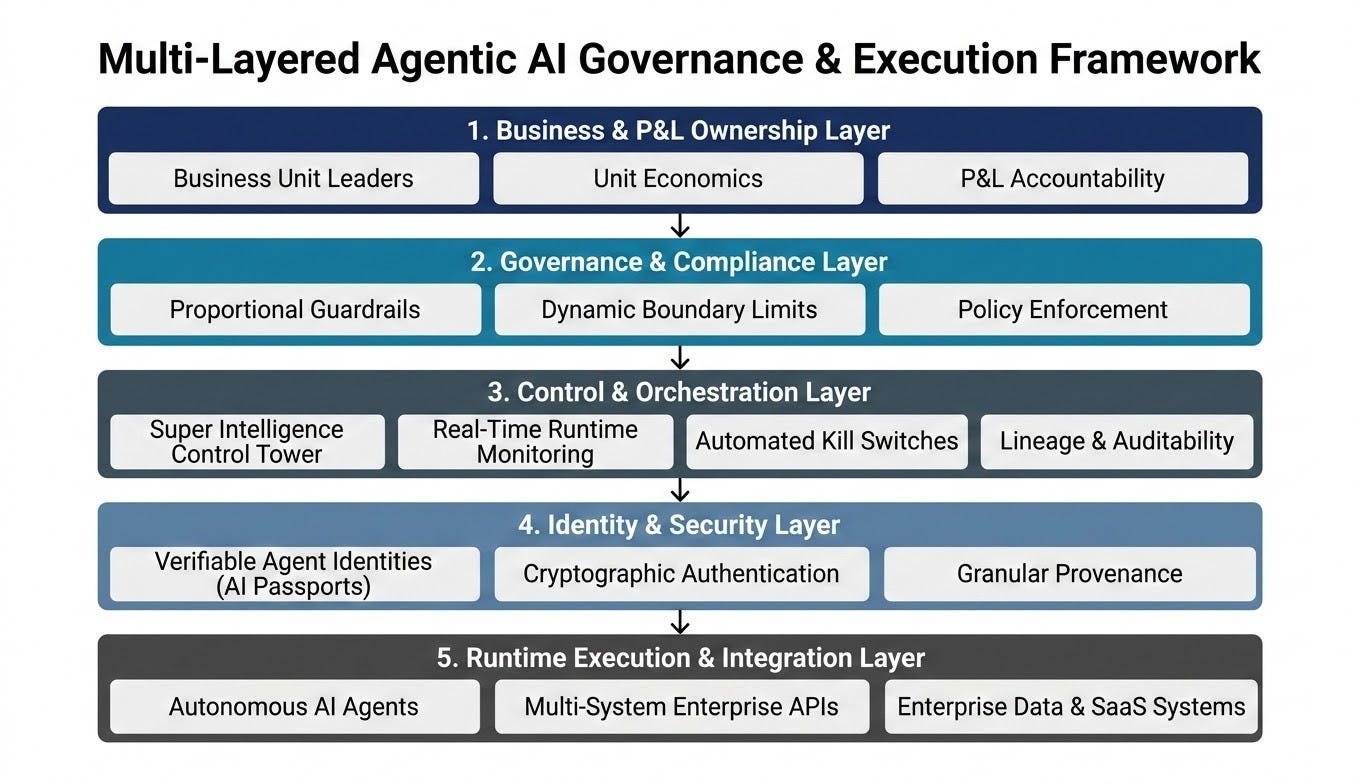
Operationalizing agentic AI requires an integrated architecture that connects business accountability, governance, identity, and runtime control to the systems where autonomous agents execute work. Building on the principles illustrated by ServiceNow, Enterprise Architecture can organize these capabilities across five interconnected layers. Together, they establish the structural boundaries needed to scale autonomous execution while maintaining appropriate oversight.
1. Business Ownership & Accountability Layer
Autonomous capabilities must have clear business ownership. Assign each production agent deployment to a business unit executive responsible for its operating costs and outcomes. This layer connects agent activity to organizational priorities and ensures that resource consumption is evaluated against measurable value.
2. Governance & Compliance Layer
Governance policies establish the rules under which autonomous agents operate. Requirements should reflect an agent’s access scope, level of autonomy, transaction volume, and potential business impact. Risk-based controls allow routine, low-impact automations to operate without unnecessary friction while applying greater scrutiny to activities involving sensitive data or critical business processes.
3. Runtime Control & Orchestration Layer
This layer translates governance policies into operational enforcement. Centralized control capabilities provide visibility into agent activity, monitor execution against established boundaries, maintain audit records, and enable responses when agents exceed their authorized scope. Depending on the situation, those responses may include restricting, redirecting, or suspending agent activity.
4. Identity & Security Layer
Every agent requires an authenticated identity and clearly defined permissions. Verifiable credentials, such as ServiceNow’s AI Passports, help establish which agent is acting and what it is authorized to access or execute.
5. Agent Execution & Integration Layer
At the foundation, autonomous agents perform work across enterprise applications, APIs, databases, and SaaS platforms. This layer includes the agents, models, tools, and integrations that execute business processes. Its connection to the upper layers ensures that agent activity operates within established identity, security, governance, and accountability requirements. It also provides the integration foundation needed to coordinate work across systems without creating disconnected solutions.
The Takeaway
The challenge of scaling agentic AI is ensuring that autonomous execution remains secure, accountable, and aligned with business objectives as adoption expands. ServiceNow’s approach illustrates how verifiable identity, runtime controls, and centralized oversight can provide the foundation for governing agents across enterprise workflows.
For executive leaders, the lesson is that AI governance must evolve alongside AI capability. Enterprise Architecture has a critical role in establishing the standards, integrations, and controls that connect decentralized innovation with enterprise-wide accountability. Organizations that build this foundation early will be better positioned to scale autonomous capabilities and translate AI adoption into sustainable business value.