

Quick Summary
Operational resilience depends on stabilizing critical processes under stress. Too often, leaders cannot see where execution is breaking down. Disruption exploits these hidden weaknesses. Process mining gives engineers and leaders quantifiable insight into how work actually happens, surfacing execution gaps and process variability that threaten stability. This briefing offers a data-driven approach to measuring and managing resilience. We lay out the steps to expose operational weak points and strengthen your organization’s most vital processes.
Background
Operational resilience depends on stabilizing critical processes under stress. Deviations from process design introduce variability, which exposes the enterprise to significant risk. Leaders often rely on financial metrics and SLAs, but the real threats arise from the way work actually flows. Disruptions begin when teams stray from standard processes, making weak points invisible until stress exposes them.
System spikes and labor gaps create massive stress on the enterprise. Process variability becomes a severe enterprise risk during these times. We must see the true movement of work. Otherwise, we cannot make the organization resilient.
Leaders can use process mining to see exactly how work actually flows through complex systems. This data-driven approach maps true operational paths, instantly pinpointing bottlenecks, skipped steps, and control gaps. It goes beyond surface-level efficiency to measure process reliability and rigorously quantify variability, which is the core threat to operational resilience. By establishing a single, objective record of how processes behave under real conditions, process mining empowers technical teams to expose weak points and drive resilient operations with Six Sigma precision.
Key Findings
Process Mining as a Resilience Capability
Process mining acts as an early warning system. It exposes critical dependencies on specific people and highlights dangerous manual workarounds. Stalled approval chains delay recovery efforts. High volumes trigger rework loops that escalate costs and delays. Essential controls disappear under pressure.
Traditional dashboards reveal outcomes but hide the way work truly moves through your systems. They mask bottlenecks and execution flaws that engineers need to see. Most audits focus on process design and miss the realities of daily execution. Interviews reflect perceptions, not what’s happening on the ground. As a result, gradual process drift and hidden inefficiencies undermine resilience long before failure rates spike; these threats are invisible in summary metrics but can be measured and corrected when you have granular, flow-level data.
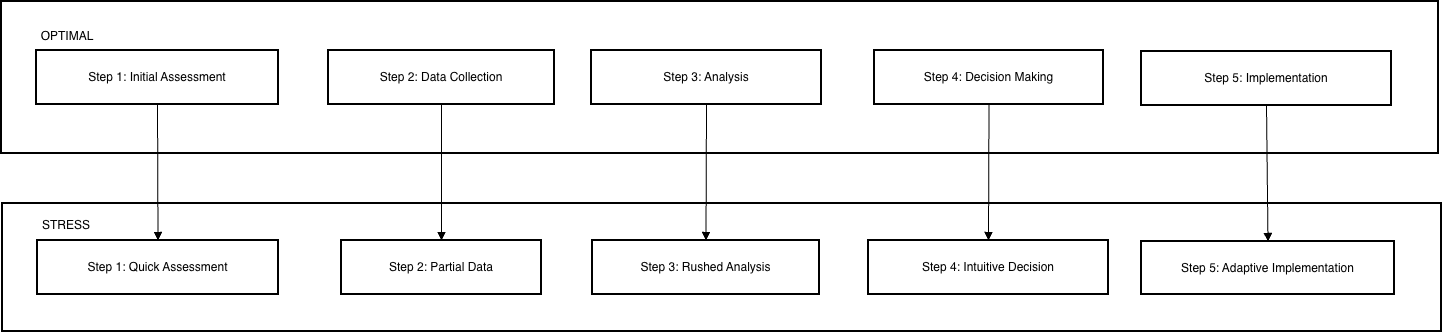
Designed Process Steps vs Actual Executed Variations Under Stress
Six Sigma Alignment
We align this visibility directly with Six Sigma methodology, applying operational discipline to digital workflows.
First, we define the scope by identifying resilience-critical processes across the enterprise, such as cash flow cycles and incident recovery protocols.
Next, we measure operations at the population level. Instead of relying on small data samples or averages, we use system logs to establish a firm baseline for process stability.
Then, we analyze the data to identify high-variance paths, isolating areas of intense risk and rework.
Afterward, we improve the process by simplifying execution paths, reducing inter-departmental handoffs, and removing unnecessary approvals to design for stability under stress.
Finally, we continuously control the system. By embedding this visibility into the daily operating cadence, we monitor data for process drift and detect early signs of performance degradation, ensuring it’s an ongoing effort, not a one-time project.
Analysis
Invisible Friction and Operational Debt
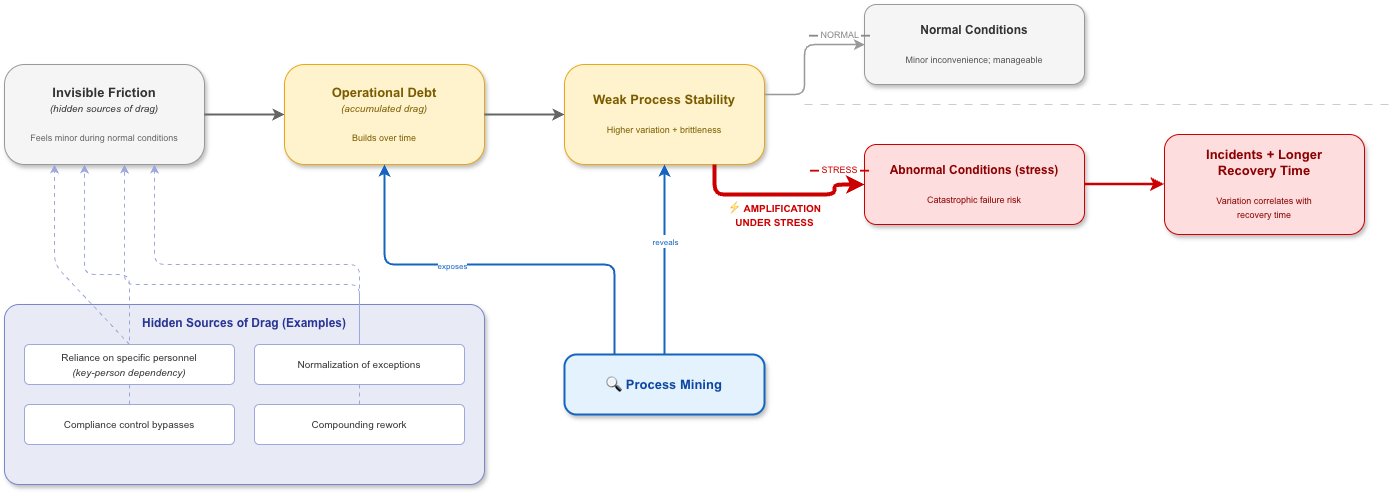
Invisible friction builds up as operational debt and weakens process stability. Operational excellence hinges on the ability to identify and eliminate these hidden sources of drag, including reliance on specific personnel, normalization of exceptions, compliance control bypasses, and compounding rework. By targeting these weak points, leaders ensure that processes remain stable and efficient, even when the system is under stress.
This friction seems like a minor inconvenience during normal conditions. It becomes a catastrophic failure during abnormal conditions. Process mining exposes this operational debt clearly. It forces a leadership control conversation. You can no longer ignore the execution reality.
Invisible Friction → Operational Debt → Failure Under Stress
Strategic Value for the C-Suite
Operational visibility enables executives to stabilize cash flow, maintain customer trust through consistent performance, and proactively reduce enterprise risk.
The Chief Financial Officer gains cash flow resilience. Process mining stabilizes order-to-cash cycles during demand volatility. It prevents revenue leakage.
The Chief Operating Officer maintains customer trust. The organization sustains fast response times under heavy load. The operations team reduces recovery time during major incidents. Heroic efforts become unnecessary.
The Chief Risk Officer protects the enterprise proactively. Process mining detects compliance drift before official audits. It flags bypassed controls immediately. The risk team shifts from reactive mitigation to proactive prevention.
Gain a data-driven understanding of your enterprise and the true resilience of your key processes. By quantifying your financial exposure and linking it directly to variability and rework, you can build a prioritized improvement agenda based on concrete impact, not subjective opinions. This approach provides ongoing visibility into the health of your execution, enabling you to make smarter, more informed decisions.
This strategic initiative requires no operational disruption. It involves no workforce surveillance. It simply uses existing system data to protect the business.
Recommendations
You must make resilience measurable and managed. This requires immediate action from the executive team. You have clear options to implement this discipline today.
Select one resilience-critical process immediately. Focus on order-to-cash or customer incident response. Do not attempt to map the entire enterprise at once.
Establish a truth baseline for this specific process. Map the actual execution paths using system data. Identify the variance between the design and the reality.
Target variability and fragility explicitly. Do not focus exclusively on cost reduction. Optimize the process for stability under high stress.
Demand ongoing visibility from your leadership team. Require your managers to continuously monitor process drift. Make process mining a core component of your monthly operational reviews.
Make Resilience Measurable
Operational resilience starts with clear, data-driven visibility. Use process mining to regain control over operational stability and actively reduce enterprise risk. By integrating Six Sigma principles into digital workflows, leaders can identify sources of variability, streamline execution, and strengthen the organization’s ability to absorb disruption.
Move beyond static dashboards and assumptions; make resilience measurable by mapping how your processes truly perform under pressure. Address operational debt directly, protect profitability, and safeguard customer trust in every critical workflow.