

Core Thesis
Fragmented AI deployments erode gross margins and accelerate process entropy. Unfortunately, these uncontrolled rollouts happen all too often. What is the solution? An Enterprise AI Control Plane is a centralized layer that governs AI access, routes requests across models, enforces security policies, and monitors costs and performance. When configured correctly, it can use TOGAF architectural abstractions and Lean Six Sigma defect-reduction principles to translate AI performance into P&L growth.
The Control Deficit
Recent research from Deloitte Insights highlights how fragmented AI deployments can create systemic enterprise risk. As business units independently adopt models and agents, central visibility breaks down. Costs become harder to predict, compliance risks become harder to monitor, and leadership loses a clear view of how AI is affecting the business. Without an overarching governance framework, decentralized execution degrades gross margins and introduces crippling operational friction.
Without centralized control, three problems emerge:
Audit and Compliance Exposure: Fragmented execution channels make it difficult to track AI activity, audit data flows, and manage risk consistently across the enterprise.
Unpredictable Operating Costs: Unrouted queries, excessive model usage, and recursive AI workflows can turn small unit costs into significant and unpredictable operating expenses.
Process Variation: Application-level controls introduce unnecessary variance, directly violating Lean Six Sigma principles and delaying strategic execution.
The Architecture Shift
Ad-hoc security policies and siloed compliance checks slow time-to-market and force leadership to choose between speed and risk management. The alternative is to move shared controls out of individual applications and into a centralized AI Control Plane. Centralizing routing, risk enforcement, and financial telemetry gives the enterprise a consistent way to govern AI while preserving the flexibility to change models as business needs evolve.
Embedding compliance and security logic inside individual business tools creates duplicated controls, which drives up maintenance costs. At the same time, coupling applications directly to specific model providers limits financial flexibility. A centralized routing layer allows organizations to shift workloads toward lower-cost or higher-performing models as pricing, performance, and business requirements change.
The Four-Tier Control Plane Architecture
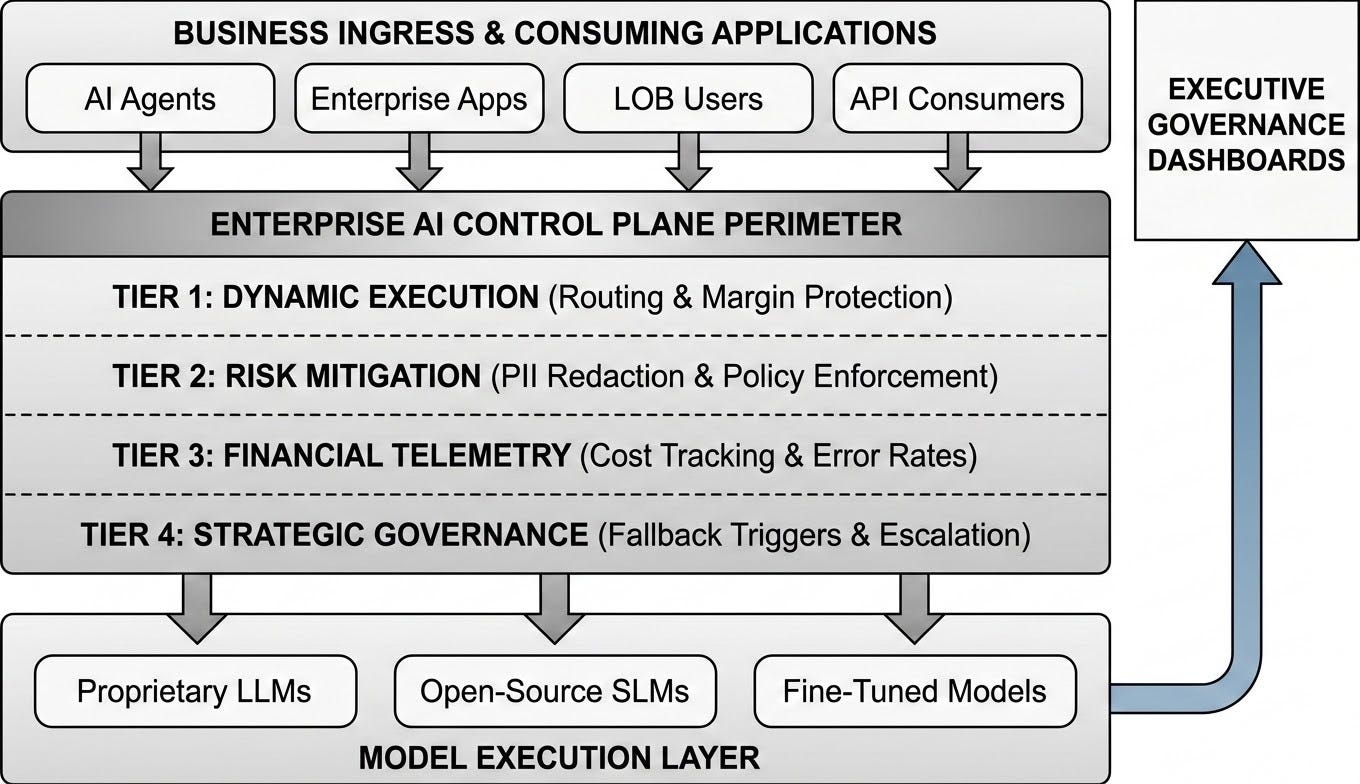
The AI Control Plane should be a shared architectural layer that sits between the business and the underlying AI models to provide consistent control over how AI is executed across the enterprise.
Four core capabilities make up the Control Plane.
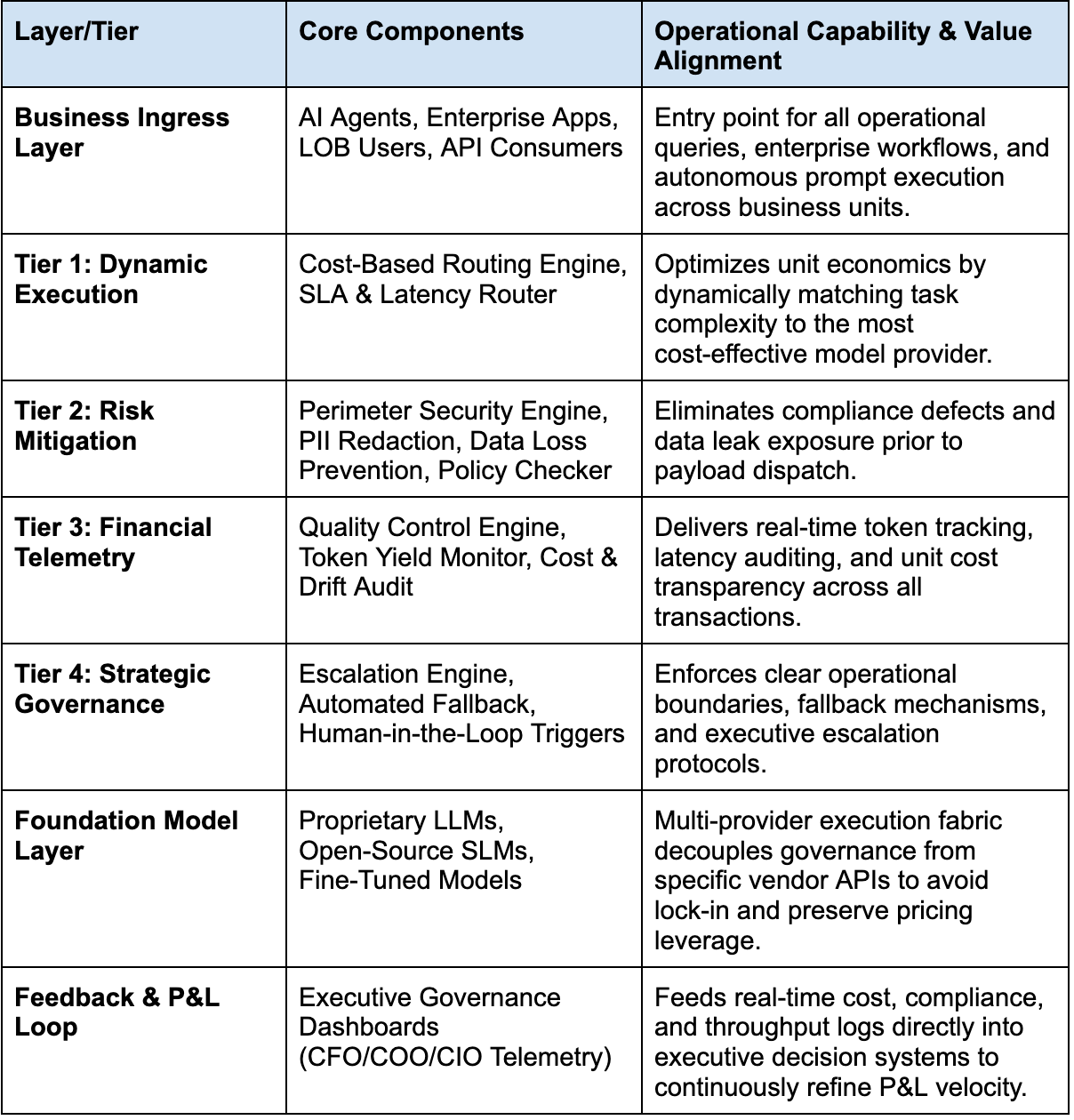
Dynamic Execution manages how AI workloads are routed.
Risk Mitigation applies security, privacy, and policy controls.
Financial Telemetry measures cost, quality, and performance.
Strategic Governance manages exceptions, escalation, and human oversight.
Together, these capabilities create a common control layer that can sit across business applications, AI agents, APIs, and model providers. Applying TOGAF architectural principles can help separate these capabilities from individual implementations, allowing organizations to reuse controls as AI adoption expands rather than rebuilding them for every application.
Logical Component Breakdown
The Economics of the Control Plane
The value of an AI Control Plane is not limited to controlling model spend. Its economic value also comes from reducing the total cost of managing AI across the enterprise.
Without centralized controls, every application can become its own governance environment, requiring separate security logic. As AI adoption expands, the cost of maintaining these duplicated capabilities grows with it. A shared Control Plane turns those capabilities into reusable enterprise services, reducing both technical overhead and management complexity.
The Control Plane also creates greater leverage over model economics. Centralized routing allows workloads to move between models based on cost, performance, and business requirements rather than remaining tied to a single provider. Financial telemetry then gives leadership visibility into where AI spend is increasing, where performance is declining, and where resources can be reallocated.
This creates an important economic advantage: AI governance becomes a source of operating leverage rather than another layer of overhead. The more AI the enterprise deploys, the more valuable reusable controls, centralized visibility, and model flexibility become.
Scaling Execution
Leadership should focus less on the underlying model and more on the economics, risk, and execution of AI across the enterprise. A centralized AI Control Plane gives executives the visibility and control needed to protect operating margins, manage compliance exposure, and scale AI without rebuilding governance for every application.