

Core Thesis
As financial leaders place greater discipline around capital allocation, technology decisions can no longer be made in isolation from the economics of the business. CIOs, Enterprise Architects, and COOs must treat governance as an asset and establish a clear line of sight from technical investment to measurable P&L impact.
The Macro Signal: What the Balance Sheet Is Telling Us
The latest findings from Deloitte’s 2Q 2026 CFO Signals Survey point to a growing convergence between financial discipline and technology governance. Among 200 North American CFOs surveyed, 59% said balancing the pressure to deploy AI quickly with effective risk management is the biggest challenge to enterprise-wide AI governance.
The signal is bigger than AI. As technology becomes more deeply embedded in operations, CFOs need greater visibility into how technology investments affect cost, risk, and business performance. The question is whether the organization can translate strategic technology value into measurable economic outcomes.
The Diagnostic: Why Transformation Stalls
Many technical transformations fail because the operating architecture lacks alignment with financial controls, not because the underlying technology is flawed. When Enterprise Architects design target states using TOGAF without integrating Lean Six Sigma operational parameters or CFO capital allocation models, a structural breakdown occurs. Complexity compounds across the stack, slowing delivery and increasing fixed operational overhead.
Two structural gaps are particularly common:
The Velocity Disconnect: Engineering cycles move in bi-weekly sprints, while capital budgeting operates on static annual cycles, creating friction at the funding layer.
The Unquantified Complexity Penalty: Redundant software tools and unmanaged legacy integrations act as a tax on engineering bandwidth and operational agility.
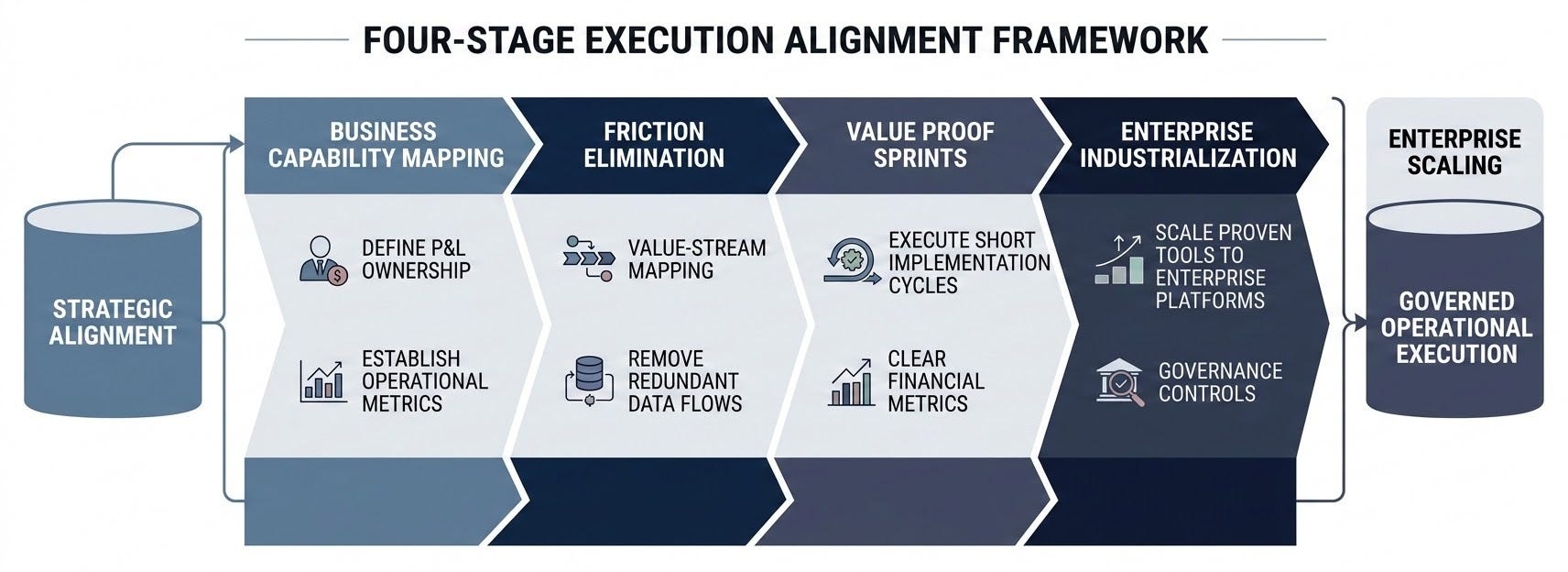
The Four-Stage Execution Alignment Framework
Governance must transition from a reactive compliance gatekeeper into a proactive engine for speed and reliability. By structuring technical oversight through an iterative framework, organizations can safely incubate innovation while enforcing strict financial and architectural guardrails.
Applying Enterprise Architecture standards alongside Lean Six Sigma waste-reduction principles allows cross-functional teams to identify and scale high-value capabilities without accumulating technical debt.
Stage 1: Business Capability Mapping. Define explicit P&L ownership and establish baseline operational metrics before allocating development budget.
Stage 2: Friction Elimination. Conduct value-stream mapping across current systems to eliminate redundant data flows and manual reconciliation loops.
Stage 3: Value Proof Sprints. Execute short-horizon implementation cycles with predefined financial and operational success metrics.
Stage 4: Enterprise Industrialization. Transition proven tools into core enterprise platforms with full vendor lifecycle management and automated governance controls.
The P&L Justification Matrix
Every architectural decision must justify its place on the balance sheet. To secure CFO support and execute effectively, technology leaders must evaluate platforms through three non-negotiable financial vectors:
Margin Expansion Impact: Does the initiative directly lower unit cost-to-serve, reduce operating expenditure, or unlock direct commercial revenue?
Total Cost of Ownership (TCO): Account for indirect costs including operational maintenance, training overhead, data governance, and ongoing security risks.
Scalability & Risk Mitigation: Ensure the architecture can handle enterprise growth factors without requiring linear additions to operational headcount.
Accelerating Enterprise Value
Uncertain economic conditions do not mean technology investment should stop. They mean the connection between investment and value must become clearer. Executive leadership must eliminate structural friction and turn governance into an accelerator for sustainable growth.
Winning organizations do not treat strategy, technology, and finance as separate disciplines. They build unified operating models where financial discipline sharpens technical architecture, delivering repeatable ROI and long-term enterprise value.